Dazaifu got its
main hall back.
The 124-year restoration finished in May 2026, so you see the real honden again — and the famous forest-roofed temporary shrine is being taken down. Most English guides still describe the old arrangement. Here's what's actually there now.
Take Nishitetsu from Tenjin (Nishitetsu Fukuoka), change at Futsukaichi, and you're in Dazaifu in about 40 minutes for roughly ¥420 (~$2.80) each way. Dazaifu Tenmangu itself is free, and as of 17 May 2026 prayers are back in the restored main hall after a once-in-124-years reroofing. Give it two hours for the shrine, the camphor avenue and grilled umegae-mochi at ¥130–180 (~$0.90–1.20); four to five if you add the Kyushu National Museum (¥700, ~$4.65, closed Mondays) and the moss garden at Komyozenji. Go before 10:00 or after 15:00 — the approach street is the crowded part.
What changed in May, and why your guidebook is wrong
The 2026 fact nobody has updatedFor three years the thing everyone photographed at Dazaifu was a temporary building. That era just ended.
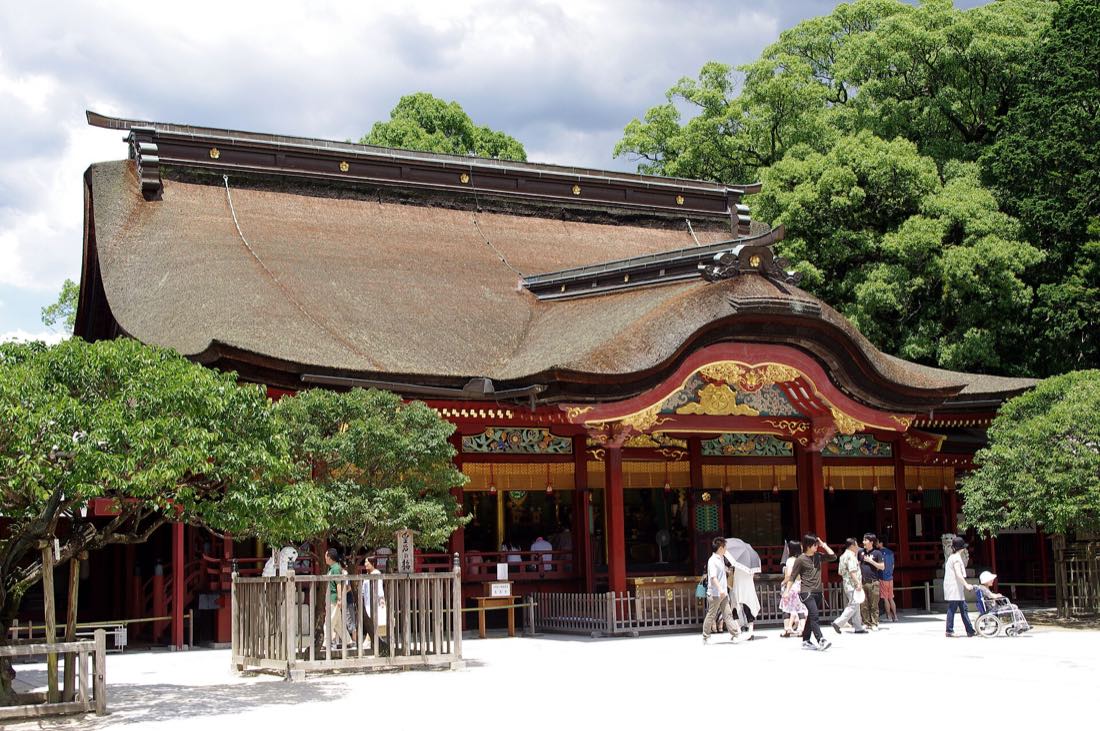
Dazaifu Tenmangu's main hall reopened on 17 May 2026 after its once-in-124-years reroofing — confirmed on the shrine's own Japanese site, which its English pages haven't caught up with yet. Sou Fujimoto's famous forest-roofed temporary hall is now being dismantled: if a guide tells you to 'see the temporary shrine before it's gone,' that window has closed. You're back to the real thing, freshly roofed.
The background, briefly: the honden is an Important Cultural Property and entered its first major restoration in 124 years in May 2023, timed toward the 1,125th-anniversary grand festival of Sugawara no Michizane in 2027. While it was wrapped, architect Sou Fujimoto built a temporary hall in front of it with 46 plant species growing on a floating forest roof — explicitly a three-year structure, and one of the most photographed objects in Kyushu. Prayers moved back to the restored main hall on 17 May 2026, and the shrine has since posted a notice about worshipping during the temporary hall's dismantling.
What that means for your visit, honestly. You will see the restored honden, freshly roofed, which is the better object and the whole point of the project. You may also see dismantling works in front of it — the shrine said the takedown would proceed slowly over about three months, during visitor hours. Don't come expecting the forest roof; do come expecting a working shrine mid-transition, with the anniversary festival year ahead of it in 2027. Anyone still selling you 'see the temporary shrine before it's gone' is reading a 2024 press release.
The practical bit
Plan the tripWhen to be on the approach street
The day, hour by hourThe shrine grounds absorb people well; the 300-metre shop-lined approach does not. Time your arrival to it, not to the shrine.
Peak approach congestion, especially weekends. The Starbucks queue becomes a landmark in itself.
Every Dazaifu stop, priced and called
What's actually thereDollar figures convert at ¥150 = $1.
| Stop | Cost | Time | Verdict |
|---|---|---|---|
| Dazaifu Tenmangu — the restored honden | Free | 45–60 min | WORTH IT |
| Kyushu National Museum — one of only four in Japan | ¥700 (~$4.65) | 1.5–2 h | WORTH IT |
| Komyozenji moss and rock garden | ~¥200–500 (~$1.35–3.35) | 20–30 min | WORTH IT |
| Umegae-mochi on the approach | ¥130–180 each (~$0.90–1.20) | 10 min | WORTH IT |
| The Kengo Kuma Starbucks — 2,000 woven cedar battens | Free to look at | 5 min | DEPENDS |
| Kamado Shrine (Homangu Kamado) | Free · ¥100 (~$0.65) community bus | 30–60 min | DEPENDS |
| Dazaifu government ruins — an open field of foundation stones | Free | 20 min | DEPENDS |
| Kanzeon-ji and Kaidan-in | Small treasure-hall fee (verify on site) | 30 min | DEPENDS |
The museum is reached from the shrine grounds through a moving-walkway tunnel lit in shifting colour — a two-minute walk that children treat as an attraction in its own right. Skip the museum if you have under four hours in Dazaifu; its permanent gallery is broad rather than deep.
Why it's full of teenagers in February
The shrine, in contextDazaifu Tenmangu enshrines Sugawara no Michizane, a 9th-century scholar-bureaucrat exiled here after court intrigue and later deified as the god of learning. That single fact explains the crowd composition: this is where Japanese students buy academic-success charms and write exam wishes on wooden ema, and January and February are peak student season. If the grounds feel like a school trip, that's because they partly are — and it's the most alive a shrine gets.
The other seasonal draw is the plum. Roughly 6,000 plum trees stand on the grounds — Michizane's emblem — peaking from mid-February into early March, led by the Tobiume, the 'flying plum' that legend says followed him from Kyoto and which blooms first each year. Autumn brings maples, and the camphor avenue on the approach is beautiful in any month. Full seasonal timing: best time to visit.
Two add-ons worth knowing. Kamado Shrine, a ¥100 (~$0.65) community bus ride uphill, is widely called the Demon Slayer shrine — that link is fan inference from a shared surname and the author's Fukuoka roots. The shrine has never claimed it and sells no character goods, so go for what it actually is: a 1,350-year-old matchmaking shrine with a striking 2012 amulet office and superb late-November foliage. And the new Open Top Bus Dazaifu route runs from Nishitetsu Tenjin Expressway Bus Terminal, 3F, Stop 0 — moved there on 28 March 2026, so ignore any guide still saying City Hall. It's ¥2,000 (~$13.33) flat and it is not hop-on-hop-off: the bus page has the detail.
The two things worth paying for at Dazaifu
Book, if you want more than a train ticketYou do not need a tour to visit Dazaifu — the train is ¥420 and the shrine is free. Book a guide if you want the Michizane story told properly, or a kimono if the photographs are the point.
Dazaifu, answered
FAQPage schema pairedIs Dazaifu worth the day trip from Fukuoka?
Yes — it's the one day trip we'd call close to compulsory for a first-timer. Forty minutes each way and about ¥420 (~$2.80) is the cheapest meaningful trip out of the city, the shrine is free, and since May 2026 you see the restored main hall rather than a temporary structure. Two hours is enough for many people; four to five is better.
Is the main hall open, or still under renovation?
Open. The 124-year reroofing finished and prayers returned to the restored honden from 17 May 2026, confirmed on the shrine's own Japanese site — its English pages haven't been updated, which is why so many guides still say 'under restoration'. Dismantling works on the temporary hall in front of it were still under way through summer 2026.
Can I still see the Sou Fujimoto forest-roof temporary shrine?
No. It was always a three-year structure and it is being dismantled — the shrine posted a notice about worship during the takedown. If a page tells you to hurry and see it, that page is out of date. Photographers should pivot to the camphor avenue, the restored honden, and Komyozenji's moss garden.
How do I get to Dazaifu from Hakata Station?
Two subway stops to Tenjin (¥210), then Nishitetsu from Nishitetsu Fukuoka with a change at Futsukaichi — about 40 minutes and roughly ¥420 (~$2.80) on the Nishitetsu leg. Note that no JR Kyushu pass covers this: Nishitetsu is a private railway. The Dazaifu Liner bus from Hakata Bus Terminal is a direct alternative at about ¥700 (~$4.65).
Is the Kyushu National Museum worth ¥700?
If you have four hours or more in Dazaifu, yes — it's one of only four national museums in Japan and the newest, telling the story of Japan's exchange with Asia, which is exactly the right subject in this city. It's closed Mondays, opens 09:30 with last entry 16:30, and the colour-lit moving-walkway tunnel from the shrine grounds is a genuine kid-pleaser.
Should I combine Dazaifu with Yanagawa?
It's the standard move and Nishitetsu built a ticket for it: ¥3,620 (~$24) digital covers round-trip rail to both towns plus the Yanagawa punt, against about ¥4,040 (~$27) piecemeal. Budget 8–10 hours and leave Tenjin by 09:00. The punting detail is on the Yanagawa page.
When is Dazaifu least crowded?
Before 10:00 or after 15:00 on a weekday. The shrine grounds handle crowds fine; the 300-metre approach street is where the congestion lives. Avoid January and February weekends if you dislike crowds — that's peak exam-charm season and the place fills with students.
What should I eat there?
Umegae-mochi: grilled rice cakes with red bean, ¥130–180 (~$0.90–1.20), sold hot from a dozen shops on the approach, stamped with a plum blossom. Eat them standing, buy two, and don't bother saving one for later — they're a different food cold. More on the region's eating: what to eat in Fukuoka.