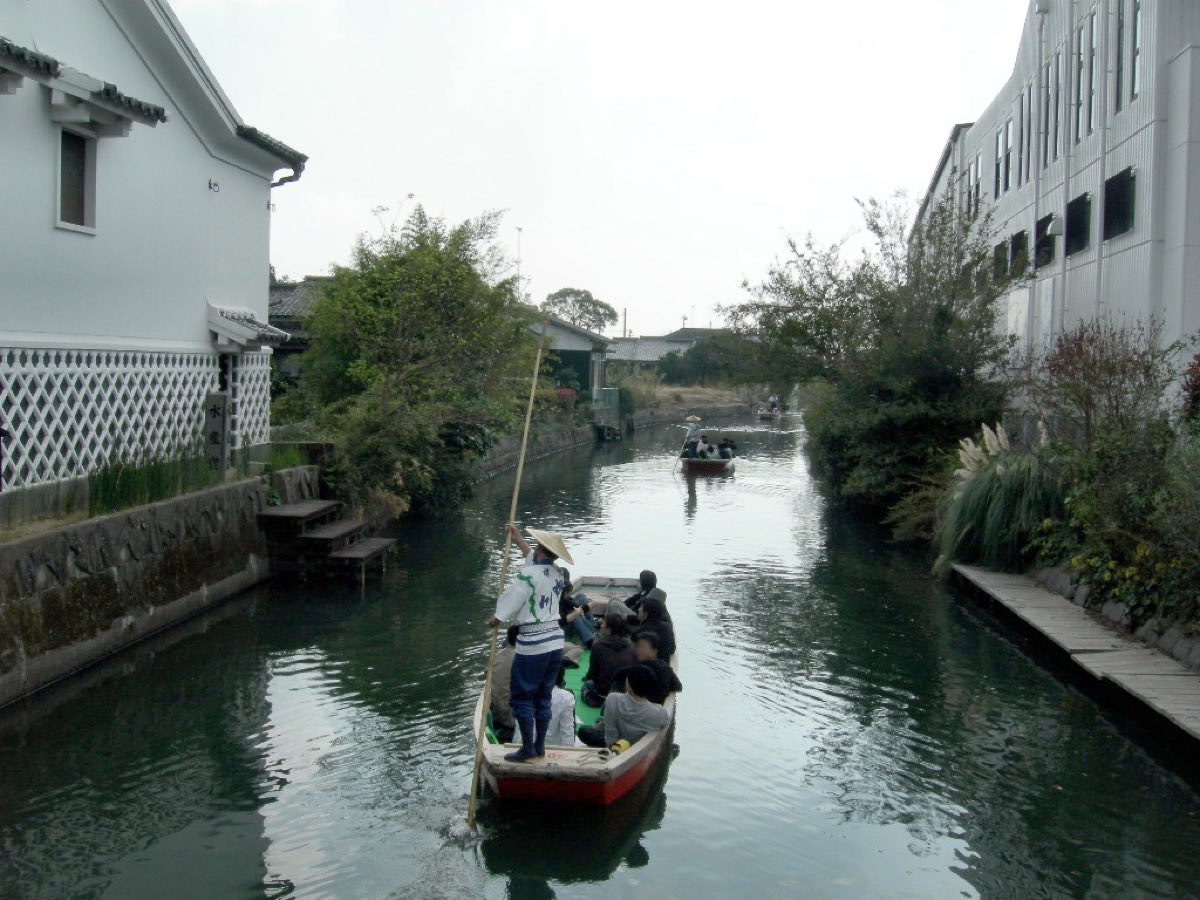
A singing boatman,
then eel in a box.
Fifty minutes south of Tenjin, a flat-bottomed punt slides under stone bridges while the boatman sings. Then you eat eel steamed over rice in a bamboo box. It is the least strenuous good day Kyushu offers.
Nishitetsu limited express from Tenjin to Nishitetsu-Yanagawa takes about 50 minutes and costs ¥610 (~$4) each way. The one-way donkobune punt is ¥2,000 adult / ¥1,000 child (~$13.35 / $6.65) for roughly 60 minutes, with boarding 09:10–15:30 and a free shuttle back to the station. Lunch is unagi seiro-mushi — eel grilled then steamed over seasoned rice in a bamboo box — at roughly ¥3,000–5,000 (~$20–33). Buy Nishitetsu's Dazaifu & Yanagawa ticket at ¥3,620 (~$24) digital: it covers rail to both towns plus the boat, against about ¥4,040 (~$27) bought separately.
The boatman is the product
What you're actually buyingThe canals are pretty. The reason 237 reviewers put this top of everything in Yanagawa is the man with the pole.
A donkobune is a flat wooden punt, poled rather than rowed, carrying a dozen or so passengers low on the water through a moat network the Tachibana clan dug around their castle town. The route runs the 'seven bends, seven turns' from Shimohyakucho toward Ohana, and it takes about an hour. The boatman narrates, jokes and sings folk songs as he works — reviewers describe the hour as stepping back in time, and the trip rates 4.2 on TripAdvisor across 237 reviews, the top-rated thing to do in the town. Nobody complains about the price.
The honest complaints, all real and all survivable: several bridges are low enough that you genuinely have to fold yourself flat as the boat passes under, some stretches of water sit still and green in summer, and heavy rain raises the level enough to disrupt service. Umbrellas are banned on board for obvious reasons; free ponchos are handed out in rain and free sun hats in summer. From 1 December to 28 February the boats run with kotatsu — a heated table under a blanket — which is the single most charming version of this trip and the reason to consider a winter visit.
Timing quirks worth knowing before you commit a date. In February the sluices are lowered for maintenance, which forces the shortened U-turn course at ¥1,800 / ¥900 (~$12 / $6) and roughly 30 minutes instead of 60. A summer-only route operates July to September. Several operators run near-identical services at near-identical prices, so there is no comparison shopping to do — turn up, buy, board within half an hour.
The practical bit
Plan the tripWhen the punt is at its best
By monthThe boat runs year-round. What changes is what you're sitting in, and in February how long the ride is.
Rain doesn't cancel the trip — high water does. If a typhoon or a heavy rainband is forecast, keep Yanagawa flexible and swap in an indoor day: rainy-day Fukuoka.
Unagi seiro-mushi, and why it's different here
Lunch is the other halfYanagawa's dish is unagi seiro-mushi: eel grilled over charcoal, laid on rice already seasoned with the sauce, then the whole bamboo box steamed so the flavour goes all the way down. It is not the Tokyo kabayaki you may have had — the rice is the point as much as the fish. The two canonical houses are Ganso Motoyoshiya, founded in 1681, and Wakamatsuya; Tsugumi, Fuji-ya and Tanaka are the everyday alternatives. Expect roughly ¥3,000–5,000 (~$20–33) for a set, with premium and large portions pushing past ¥6,000 (~$40).
Every price on this page was checked in early August 2026 against official or primary sources. Japanese attraction prices move and English sources go stale fast; where we couldn't verify a number, we say so instead of guessing.
On that last point, plainly: the eel houses publish menus on paper and on their walls, not on the open web, so treat the ¥3,000–5,000 band as the market rate rather than a quoted price. Nishitetsu also sells a 'Yanagawa Tokumori' ticket bundling rail, the boat and an eel meal — we could not confirm its 2026 price, so we're not printing one. Ask at the Nishitetsu Tenjin ticket counter; if it's running at a sane number it's the one-transaction answer to the whole day.
The queue is real: 11:30 to 13:30 is when every boat that launched at 10:00 arrives hungry at the same six restaurants. Eat at 11:00 before your boat or after 14:00 following it, and you'll walk in. While you're waiting, Ohana — the Tachibana family villa with a Meiji-era Western wing and the Shoto-en pine-and-pond garden, a designated Place of Scenic Beauty — is the sensible filler at around ¥1,000 (~$6.65), a figure worth confirming at the gate.
The boat, three ways
Book ahead, or don'tYou can absolutely turn up and buy a punt ticket on the day — the operators run continuously and the wait is usually under half an hour. Pre-booking buys certainty on a weekend, and a private guide buys the story.
Yanagawa, answered
FAQPage schema pairedIs Yanagawa worth a day trip on its own?
As a standalone it's thin for a first-timer with limited days — a boat ride and a lunch. Paired with Dazaifu on the ¥3,620 (~$24) combo ticket it becomes one of the best days out of Fukuoka, roughly 8–10 hours door to door. If you have four or more days in the city, do it solo and take it slowly; if you have two, pair it.
How much is the boat ride and how long does it take?
¥2,000 adult, ¥1,000 for children 5–12 and ¥500 for under-5s needing their own seat (~$13.35 / $6.65 / $3.35), for about 60 minutes on the one-way course. The shortened U-turn course is ¥1,800 / ¥900 and about 30 minutes — that's what runs during February's water-lowering period.
Do I need to book the punt in advance?
Not usually. Boarding runs 09:10–15:30 and departures leave within 30 minutes of check-in, so the practical rule is simply to arrive before 15:30. Advance e-tickets exist and make sense on a spring weekend or if you're travelling with a group that can't absorb a wait.
Is the combo ticket with Dazaifu actually good value?
Yes, unusually so. À la carte the day runs about ¥4,040 (~$27): ¥410-ish each way to Dazaifu, ¥610 each way to Yanagawa and ¥2,000 for the boat. The ticket is ¥3,620 digital (~$24) and includes all of it plus discount coupons — it saves roughly ¥400 and, more usefully, removes four ticket transactions in Japanese.
What is unagi seiro-mushi and what does it cost?
Eel grilled over charcoal, then steamed in a bamboo box over rice that's already been seasoned with the sauce — the rice absorbs everything, which is the local difference. Sets run roughly ¥3,000–5,000 (~$20–33), higher for premium portions. Ganso Motoyoshiya has been doing it since 1681; queues peak 11:30–13:30.
Is it good with children?
Very. An hour on a slow boat with a boatman performing, low bridges to duck under as a game, and a short walk to lunch — it's one of the easiest good days in the region with kids, and the winter kotatsu boat is a genuine novelty. Full family planning: Fukuoka with kids.
Does a JR pass cover Yanagawa?
No. Yanagawa is served by Nishitetsu, a private railway, and no JR Kyushu pass touches it — the same trap applies to Dazaifu. If your Kyushu plan is mostly Nishitetsu day trips, the JR pass is dead money: the arithmetic is on the pass page.
What if it rains?
The boats run in rain and hand out free ponchos; umbrellas are prohibited on board. What actually stops service is high water after heavy rain, so check the forecast for volume rather than for drizzle. Yanagawa in light rain, under a poncho, is atmospheric rather than ruined.