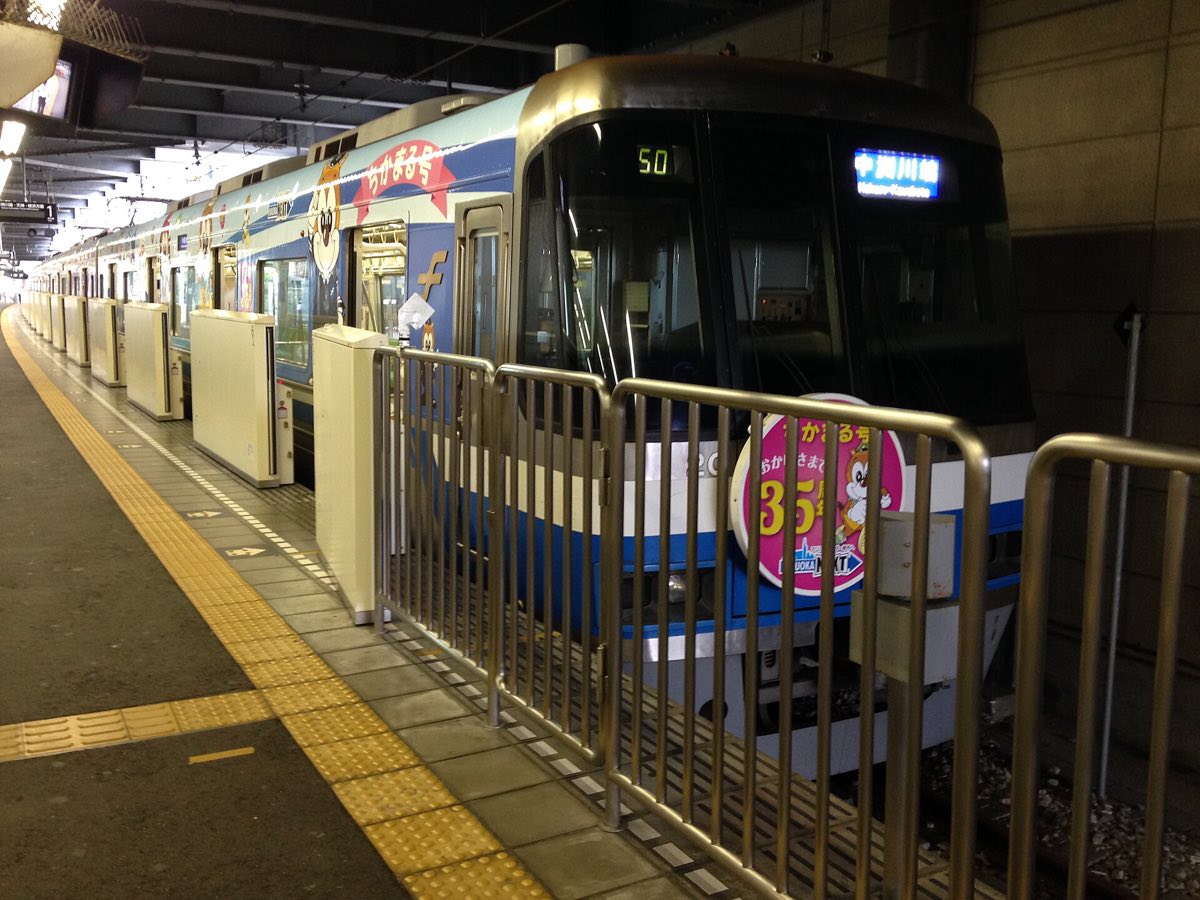
A city you mostly walk —
and a ¥210 subway for the rest.
Hakata and Tenjin — the two downtowns — are a 20-minute walk apart. Three subway lines cover everything else from ¥210, the centre has a ¥150 flat-fare bus zone, and the gates take foreign contactless cards. Here's the whole system, with the stale numbers corrected.
Walk the centre — Hakata Station to Kushida Shrine is 15 minutes, Hakata to Tenjin about 20 — and use the subway for everything longer: three lines, ¥210 (~$1.40) base fare, ¥260 to the airport, gates that take foreign contactless credit cards directly. Buses charge a flat ¥150 (~$1) in the city-centre zone. Skip the ¥2,500 Tourist City Pass — a realistic day uses about ¥1,440 of fares — and know that the subway stops around 00:25 while the bars run to 2–3am: budget a ¥1,000–2,000 taxi if you're out late.
Two downtowns, twenty minutes apart
The shape of itFukuoka's defining logistical fact: its two centres are a 20-minute walk from each other. It's why a city of 1.6 million feels smaller and easier than anywhere comparable in Japan.
Hakata is the station side — shinkansen, airport subway, the temple circuit, most hotels. Tenjin is the shopping and nightlife side. Between them: Canal City, Kushida Shrine and the Nakasu yatai row, all on the walking line. The walk is genuinely pleasant; the subway does it in 5 minutes for ¥210 if it's raining or it's August.
Every location on this site carries its subway line, station and exit — Fukuoka has three lines (Kūkō/Airport, Hakozaki, Nanakuma) and a flat, legible core. Much of the centre is genuinely walkable: Hakata Station to Kushida Shrine is 15 minutes on foot, Tenjin to Ohori Park about 20.
The three lines, practically: the Kūkō (Airport) line is the tourist line — airport, Hakata, Nakasu-Kawabata, Tenjin, Ohori Park, and Tōjinmachi for the PayPay Dome. The Hakozaki line branches to Gofukumachi (the sumo venue) and Hakozaki Shrine. The Nanakuma line matters for one station: Kushida-Jinja-mae, opened 2023, which puts the temple district one stop from Hakata Station.
How each way of moving actually prices out
Mode by modeFares checked August 2026 against operator sites. Dollar prices convert at ¥150 = $1, the rate used across this site in August 2026. Treat converted figures as close, not exact.
| Mode | Cost | Good for | Verdict |
|---|---|---|---|
| Walking | Free | Hakata↔Tenjin and everything between | DEFAULT |
| Subway | ¥210–260 (~$1.40–1.75) | Airport, Ohori Park, the dome | WORTH IT |
| Nishitetsu bus | ¥150 flat in the centre zone | Fukuoka Tower, Momochi, odd gaps | WORTH IT |
| Taxi | ~¥700–750 flagfall | After the 00:25 last subway; groups with bags | DEPENDS |
| Charichari bike share | ¥6.5/min (~$2.60/hr) | Short A-to-B hops on a flat city | DEPENDS |
| Tourist City Pass | ¥2,500 (~$16.70) | Nothing — a real day uses ~¥1,440 | SKIP |
Taxi flagfall is roughly ¥700–750 — sources disagree on the exact figure, so treat it as approximate. The GO app dispatches licensed taxis (there is no private-driver rideshare in Japan; Uber sends taxis too). Charichari's per-minute pricing means a 20-minute hop costs ¥130 — cheaper than the subway — but an hour of sightseeing on an e-bike runs ¥1,230 (~$8.20).
IC cards, contactless, and the pass question
Cards at the gateA visitor arriving with a Suica needs to buy nothing. A visitor with a contactless credit card may not even need that.
Fukuoka's three local IC cards — Hayakaken (subway), nimoca (Nishitetsu) and SUGOCA (JR Kyushu) — are all part of Japan's ten-card mutual-use scheme, so Suica, PASMO, ICOCA and the rest work on the subway, Nishitetsu buses and trains, and JR local lines here. If you're coming from Tokyo, the card in your phone already works.
The newer option: all 36 subway stations take contactless credit cards at dedicated readers — Visa, JCB, American Express, Diners Club, Discover and UnionPay. Tap in, tap out, no ticket machine. Note the operator's accepted list doesn't include Mastercard. A daily fare cap on contactless matching the ¥640 day pass is widely reported, but we couldn't confirm the daily figure against a primary source — treat the paper pass as the guaranteed ceiling. Contactless works at subway gates only; buses still want an IC card or cash.
The subway's own 1-day pass is ¥640 adult / ¥320 child (~$4.25/$2.15) from any ticket machine, with small discounts at some attractions. Three ¥260 rides and it's paid for itself. Skip the Fukuoka Tourist City Pass. It costs ¥2,500 (¥2,800 with Dazaifu) and a realistic city sightseeing day uses about ¥1,440 of actual fares — the pass loses you money, and it doesn't even cover the Dazaifu 'Tabito' liner. Older guides quote roughly half the current price; they're stale. Pay per ride, or use a contactless card at the gates.
How to ride a Nishitetsu bus (it's backwards from Tokyo)
The bus, decodedThe city-centre flat bus fare is ¥150 — it went up from ¥100 on 1 July 2021, and 2026-dated guides still print the old number. Hakata Station to Tenjin by subway is ¥210; the bus is ¥150 in the flat zone.
Cash payers take a numbered paper ticket from the orange box as they board; IC card holders tap on entry. The front door is the exit.
The screen up front shows the next stop and the fare due for your ticket number, rising as you ride. Inside the flat zone — roughly Hakata Station to Tenjin to Yakuin — it's ¥150 no matter what.
Drop your ticket plus exact fare in the box, or tap your IC card again. Press the stop button early — stops come fast in the centre.
The farebox changes ¥1,000 notes and ¥500/¥100/¥50 coins only — no ¥5,000 or ¥10,000 notes, and it rejects the new-design ¥500 coin. Sort change at a konbini before boarding.
The single most common bus fluster for visitorsFukuoka's double-decker Open Top Bus now departs from the Nishitetsu Tenjin Expressway Bus Terminal, 3F Stop 0 — it moved from City Hall on 28 March 2026 — running three routes at a flat ¥2,000 (~$13.35). It's a guided loop, not hop-on-hop-off, and there's a real case for it on a first morning. The full verdict, routes and booking detail are on its own page.
The open-top bus, judgedThe transit questions everyone asks
FAQPage schema pairedCan I use my Suica or Pasmo from Tokyo in Fukuoka?
Yes — the national ten-card scheme covers Fukuoka's subway, Nishitetsu buses and trains, and JR Kyushu local lines. Top up at any station machine or konbini. The one thing it won't do is come back to life if the balance hits zero mid-bus — keep ¥1,000 or so loaded.
Is there a day pass worth buying?
The subway's ¥640 (~$4.25) 1-day pass is the only sensible one, and only on a day with three-plus rides — airport arrival plus Ohori Park plus the dome, say. The ¥2,500 Tourist City Pass and the ¥1,200 bus day pass both lose money on realistic days. Full arithmetic: the pass page.
What time does the subway stop running?
Service runs roughly 05:30 to around 00:25. The subway stops around midnight; Fukuoka's bars and yatai run to 2–3am. That gap is the single best reason to sleep in Tenjin or Daimyo if you're here for the nightlife — or to budget for the taxi and stay in Hakata anyway, where everything else is easier.
Do Fukuoka's buses take credit cards?
Not at the farebox — buses want an IC card or cash (and the box only changes ¥1,000 notes and ¥500/¥100/¥50 coins, rejecting the new-design ¥500 coin). Contactless credit cards work at subway gates only. If you're bus-heavy for a Momochi day, load an IC card.
Is Fukuoka walkable enough to skip transit entirely?
Almost. Hakata to Tenjin is 20–25 minutes on foot past Kushida Shrine and Canal City, and the whole temple circuit is a 3.5 km walk. What breaks the pattern: the airport (subway, ¥260), Ohori Park from Hakata (¥260), and Fukuoka Tower/Momochi (bus, ¥240–260). One pair of good shoes covers the rest.
How do taxis work late at night?
Flag one on the street in Hakata, Tenjin or Nakasu — availability is excellent there — or use the GO app, which dispatches licensed taxis. Flagfall is roughly ¥700–750 and a Nakasu-to-Hakata hop after the yatai runs ¥1,000–2,000 (~$6.70–13.35). Cards and IC accepted in nearly all cars.
Should I rent a car in Fukuoka?
Not for the city — parking and the flat ¥150 bus zone make it pointless. Rent one for Itoshima's coast road, where public transport is genuinely thin. You'll need a 1949 Geneva Convention International Driving Permit; Japan doesn't accept the 1968 Vienna version.