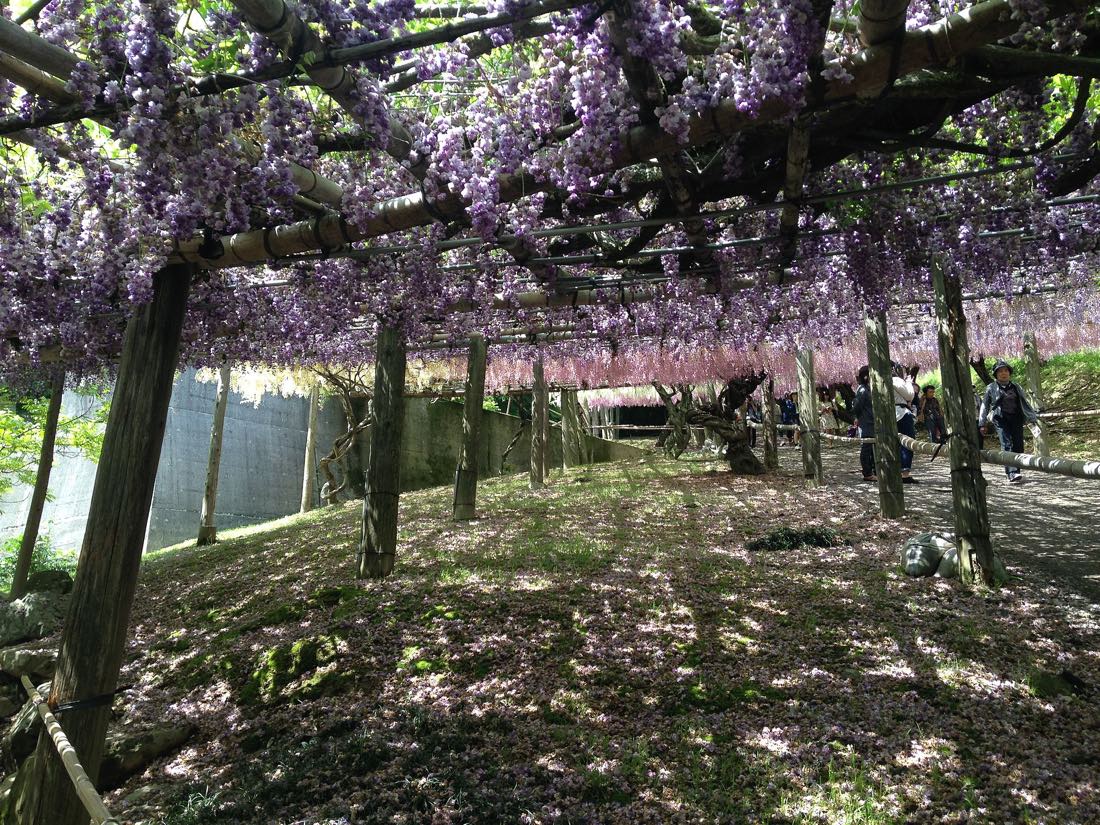
The wisteria tunnels are real.
So is the ticket system.
A private garden in the hills above Kitakyushu with two wisteria tunnels and a domed trellis, open to the public for roughly two weeks a year, on advance-only timed tickets, with no shuttle bus since 2020. Plan it in March or don't plan it.
Kawachi Fuji Garden opens for a peak wisteria period of roughly two weeks from mid-to-late April into the start of May — in 2026 the special period ran 18 April to 6 May. Entry is advance-only on timed slots: in 2026 that meant about ¥600 (~$4) for the advance ticket plus ¥500–1,000 (~$3.35–6.65) settled on site by bloom grade, so roughly ¥1,600 (~$10.65) total, across five two-hour entry windows between 08:00 and 18:00. There has been no free shuttle bus from Yahata since 2020, so plan on a taxi at around ¥3,000 (~$20) each way or a car with one of the roughly 200 free parking spaces. Treat every number here as the 2026 shape and confirm at purchase.
Why most people who want to go, don't
The trap, stated firstThis is not a garden you visit. It's a garden you get a ticket for, weeks earlier, from a Japanese-language sales channel.
Four constraints stack on top of each other, and missing any one of them ends the trip. The window is about two weeks — wisteria peaks when it peaks, and the garden sets its special period accordingly each spring; 2026's ran 18 April to 6 May. Tickets are advance-only during that period, sold online from late March and through Japanese convenience stores from around the start of April — there is no gate queue to join instead. Entry is on timed slots, five two-hour windows across the day, so you're committing to an hour as well as a date. And there is no shuttle bus: the free service from Yahata ended in 2020 and hasn't returned.
The consequence is that the people who see the wisteria are the ones who decided in March. If you're reading this in mid-April with a Fukuoka trip already booked, the honest answer is usually that this year isn't your year — and there are better uses of the day on the ranked day-trip list. If you're reading it in winter and you'll be here in late April, put a reminder in your calendar for mid-March, because that is the action that actually decides this.
One more piece of honesty: we are describing the 2026 mechanism. The garden republishes its dates, prices and sales channels each season, and the on-site portion of the fee varies with bloom grade — that's the point of splitting the price in two. Confirm the current window, price and sales route at the point of purchase rather than trusting any English page, ours included. That is the correct level of confidence to have about a private garden's ticketing system.
What to do, and when to do it
The calendarThe whole trip is decided in March. Everything after that is logistics.
The practical bit
Plan the tripWhat you get for the friction
Is it worth the trouble?Two wisteria tunnels — long trellised walkways with racemes hanging overhead in white, pink and every shade of purple — plus a large domed trellis you can stand under and look up through. It is one of the genuinely top-tier photographic subjects in Kyushu, and unlike most such places it is a private garden run to a standard rather than a public park absorbing whoever turns up. The timed slots are precisely why it still looks like the photographs: the garden caps how many people are inside at once.
Who should go: photographers, anyone visiting Japan specifically in late April, and repeat visitors who've done the standard circuit and want a spring subject that isn't cherry blossom. Who shouldn't: anyone without a car or a taxi budget, anyone travelling outside the window — the garden is simply shut, there is no consolation visit — and first-timers with two days in Fukuoka, for whom Dazaifu is a better use of a day by some distance.
If the wisteria window has closed on you, the two honest substitutes are the November-to-December foliage season at the same garden, which costs about ¥600 (~$4) and carries none of the ticket drama, or a spring day at Fukuoka Castle and Ohori Park during sakura — free, central, and the best the city looks all year. Seasonal timing for all of it: best time to visit.
No OTA sells this — and that's the point
There's nothing to buy hereNo major booking platform carries Kawachi Fujien entry: the garden sells its own advance tickets through Japanese channels and that is the only way in. We'd rather say so than send you to a generic activities page and collect a commission.
Kawachi Fujien, answered
FAQPage schema pairedWhen is the wisteria at Kawachi Fujien?
Late April into the very start of May — in 2026 the special period ran 18 April to 6 May, which is roughly a two-week window either side of the peak. The exact dates are set each year and announced in March, because they follow the bloom rather than the calendar. Outside that window the garden is closed to visitors, apart from an autumn foliage season.
How much does it cost?
In 2026, about ¥600 (~$4) for the advance ticket plus ¥500–1,000 (~$3.35–6.65) paid on site depending on how far along the bloom is — roughly ¥1,600 (~$10.65) all in. The split exists so you pay less for a half-open garden. Confirm the current structure at purchase; this is a private garden that revises its terms annually.
Can I buy tickets at the gate?
No. During the special wisteria period entry is advance-only — online from late March and through Japanese convenience stores from around the start of April. There is no on-the-day queue as a fallback. This single rule is why most people who want to visit never do.
How do I get there without a car?
Train to Yahata Station and then a taxi, around ¥3,000 (~$20) each way. The free shuttle bus that used to run stopped in 2020 and has not come back. Arrange the return taxi before you go in — this is a hillside garden, not a place where cabs cruise past.
Is it worth it if I'm only in Fukuoka for two days?
No. It's in Kitakyushu, roughly 95 minutes away plus the taxi, it needs a ticket bought weeks earlier, and it occupies a full day for one to two hours in the garden. With two days, do Dazaifu and a yatai night. Kawachi Fujien is a third-or-later-visit trip, or a trip you built the dates around.
What are the entry time slots?
Five two-hour windows spread across roughly 08:00 to 18:00, chosen when you buy. Early slots give you the best light and the thinnest crowds; late-afternoon slots are the second-best call. The middle of the day during Golden Week is the version of this garden you've seen complained about.
Is the autumn season worth considering instead?
Genuinely, yes. The same garden runs a maple season from about mid-November to early December at around ¥600 (~$4), with none of the advance-ticket machinery. It isn't the wisteria — nothing is — but it's a beautiful hillside garden on a day you can decide to visit the night before.
What else is near it?
It's in Kitakyushu, so the sensible pairing is the port district: Mojiko Retro, the Kanmon pedestrian tunnel and Kokura are all on the same side of the prefecture. If you're making the journey anyway, read the Mojiko and Kokura page and build one long day rather than two.