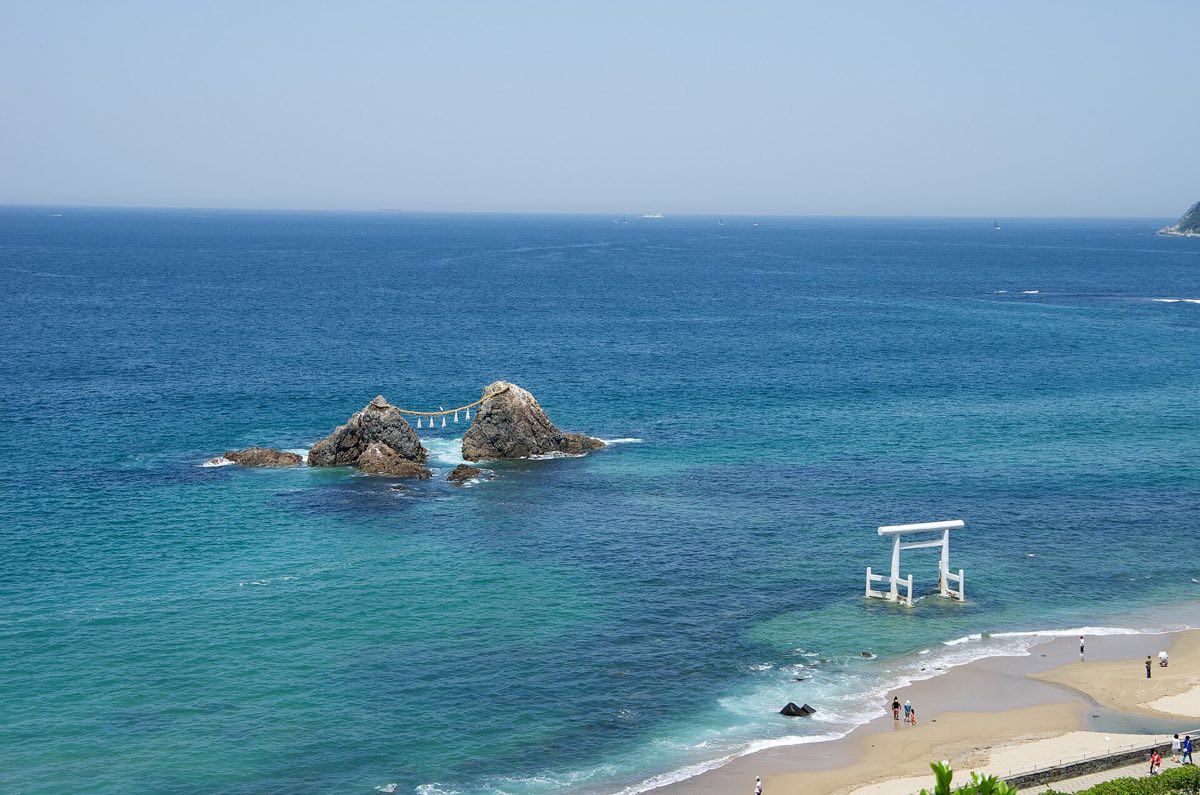
Itoshima is a car trip
that tolerates a train.
The white torii in the sea is easy. Everything else on this peninsula — the sea cave, the cafes, the winter oyster huts — is a car problem dressed as a day trip. Here is exactly what works without one, and what doesn't.
The JR Chikuhi line runs through from the Kūkō subway to Chikuzen-Maebaru in about 45 minutes for ¥590 (~$3.95) each way — and that's where the easy part stops. From Maebaru you still need a Showa bus (¥410–510 a hop, ~$2.70–3.40, sparse timetable, roughly ¥1,000 for a day pass), a rental bike (about ¥1,000 a day, ~$6.65, gone by mid-morning), a taxi or a car. Car-less, the honest plan is Sakurai Futamigaura's sea torii at sunset plus one Sunset Road cafe, budget ¥3,000–5,000 (~$20–33) all in, and be on a bus back by 18:00. With a car — or a tour that supplies one — the whole peninsula opens up, including the November-to-March oyster huts.
The transport truth every guide buries
Lead with thisItoshima is not a town. It's a 30-kilometre coastline with the good bits spread along it and one railway that doesn't go there.
The train gets you to Chikuzen-Maebaru, which is the administrative middle of nowhere. The torii, the beaches, the cafes and the oyster huts are all strung along the coast road beyond it, connected by a Showa bus network that runs often enough for locals and not often enough for a visitor with a return train to catch. Buses cost ¥410–510 (~$2.70–3.40) per hop and a day pass at around ¥1,000 (~$6.65) covers unlimited coastal rides — buy that, not singles. The last useful return bus is around 18:00, which collides directly with the sunset that is the entire reason people come.
Bikes are the good car-less answer and they have their own trap: rental near Maebaru runs about ¥1,000 (~$6.65) a day for a basic mamachari or ¥1,500 (~$10) for four hours on a cross bike, and they sell out — arrive by 09:30. Maebaru to Sakurai Futamigaura and back is roughly 25 km with real hills in places, which is a pleasant half-day on a decent bike and a grim one on a shopping bike with a headwind.
Renting a car in Fukuoka city and driving out — about 50 minutes — is what locals and most Japanese visitors do, and inventory at Maebaru itself is thin, so book the city branch. For four people, a private charter with a driver works out close to the price of four coach seats and is dramatically better here than anywhere else on the day-trip list. Say it plainly: Itoshima is a car destination that tolerates train, bike and bus. Plan accordingly and it's lovely; pretend otherwise and you'll spend the day at bus stops.
Is Itoshima for you?
Who it suitsEvery Itoshima stop, priced and called
What's actually out thereReachability assumes no car. Dollar figures convert at ¥150 = $1.
| Stop | Cost | Car-less? | Verdict |
|---|---|---|---|
| Sakurai Futamigaura — the white torii in the sea | Free, 24/7 | Yes — bus or bike from Maebaru | WORTH IT |
| Kaki-goya oyster huts (roughly Nov–Mar) | ¥1,000–1,500/kg (~$6.70–10) | Hard — scattered fishing ports | WORTH IT |
| Sunset Road cafe strip (Route 82) | ¥800–1,800 a stop (~$5.35–12) | One cafe, realistically | WORTH IT |
| Keya no Oto — Japan's largest basalt sea cave | Boat ~¥800 (~$5.35) | No — far west end, car only | DEPENDS |
| Ito no Yudokoro onsen, day use | ¥700–1,200 (~$4.70–8) | Taxi from Maebaru | DEPENDS |
| Shiraito Falls (best June–August) | Free | No — car or taxi | DEPENDS |
| Strawberry picking (roughly January–May) | ~¥2,000–2,500 for 30 min (~$13–17) | No — farms are inland | DEPENDS |
| Surf lesson at Nogita or Futamigaura | ¥6,000–8,000 for 2 h (~$40–53) | Yes, if the school collects you | DEPENDS |
Two honesty notes. The Keya no Oto sightseeing boat runs roughly 09:30–16:30 weather permitting and cancels often — never build a day around it. And the Sunset Road cafe names that fill every listicle turn over fast: treat any named cafe you read about, here or anywhere, as needing a same-week check before you ride 12 km to it.
Getting the torii shot right
The tide detail nobody mentionsSakurai Futamigaura is a white torii standing in the shallows with the Meoto-iwa 'married couple rocks' roped together behind it. It's free, open permanently, and it is the single reason this peninsula trends. Two things decide whether your photograph works. First, sunset — the gate faces west and the whole composition is built for it. Second, the tide: at low water the torii stands on wet sand and the floating effect disappears entirely. Check a tide table for Itoshima the night before and match a high-ish tide to sunset; when those two line up you have maybe a 40-minute window.
Which runs straight into the transport problem: the last useful bus back toward Maebaru is around 18:00. In midwinter the sun sets before that and it works. From roughly April to September it does not, and your options narrow to a taxi back (budget accordingly), a bike with lights, a car, or a tour that stays for sunset. That collision is the honest reason Itoshima rates DEPENDS rather than WORTH IT for anyone without wheels.
Kaki-goya, and the DIY answer to a gap in the market
The oyster hutsFrom roughly November to March — confirm with the individual hut, as opening dates vary — the fishing cooperatives at Kishi, Fukuyoshi, Karatomari and Noghita run kaki-goya: plastic-sheeted shacks where you buy oysters by the kilo and grill them yourself over charcoal. English-language booking inventory for this is close to nonexistent, which means the DIY route isn't a compromise — it's the route.
A kilo of oysters you grill yourself in a plastic shack by a working fishing port, with your own soy sauce, lemon and butter brought from a konbini — the BYO-condiments habit is local custom, not penny-pinching. Reserve at weekends; huts fill with Fukuoka families.
A guided coastal day that includes an oyster element and, critically, the vehicle. The one product in this category with meaningful English inventory.
Verdict. If you have a car or a designated driver, do it yourself — it's cheap, it's the real thing, and there's nothing a guide adds to a charcoal grill. If you don't, the tour is buying transport, not expertise, and it's a fair trade for a season that only runs a few months. Outside that window this section is moot: the huts simply aren't there.
The two products that solve the vehicle problem
If you're not drivingBoth of these exist for one reason: Itoshima's payoff is spread over 30 kilometres of coast road. Buy the wheels, not the narration.
Itoshima, answered
FAQPage schema pairedIs Itoshima doable without a car?
Partly. The train to Chikuzen-Maebaru is 45 minutes and ¥590 (~$3.95), and from there a bus or rental bike gets you to the Sakurai Futamigaura torii and one or two cafes. What is not realistically doable car-less is Keya no Oto at the far west end, the inland falls and farms, or the oyster huts. Plan the reduced version deliberately rather than discovering it at a bus stop.
How do I get to the Itoshima torii from Fukuoka?
Kūkō subway line through-running onto the JR Chikuhi line to Chikuzen-Maebaru — about 45 minutes, ¥590 (~$3.95) — then a Showa bus toward the Sakurai coast (¥410–510 a hop; buy the ~¥1,000 day pass) or a rental bike. Allow 30–40 minutes for that second leg and check the return timetable before you set off, not after.
When are the Itoshima oyster huts open?
The kaki-goya season runs roughly November through March, hut by hut — some open earlier and dates shift with the harvest, so confirm with the specific hut or the fishing cooperative before travelling. Oysters run ¥1,000–1,500 a kilo (~$6.70–10) and you grill them yourself; bring your own soy sauce and lemon, which is what everyone else is doing.
What's the best time of day to visit?
Late afternoon into sunset, for the torii. Two caveats: check the tide table, because low water removes the floating effect entirely, and check the last bus, because it leaves around 18:00 and the sun doesn't cooperate with that from spring to autumn. Morning visits work fine for cafes and beaches — just not for the photograph.
Itoshima or Dazaifu — which should I do?
Dazaifu, if you're choosing one and it's your first trip: it's cheaper, easier, car-free and has a genuine sight at the end of it. Itoshima is the better second or third day trip, especially with a car, in oyster season, or if the coast is what you came to Japan for. Both compared: day trips, ranked.
Is there anywhere to swim?
Yes — Futamigaura and Nogita are the usual beaches, with surf schools running two-hour group lessons at ¥6,000–8,000 (~$40–53). Japanese beach season is short and lifeguarded windows are shorter, so treat July and August as the swimming months and the rest of the year as walking-and-photography months.
How much should I budget?
About ¥3,000–5,000 (~$20–33) car-less for transport, one cafe and one activity. Add a taxi contingency of ¥2,000–3,000 (~$13–20) if you're staying for sunset in summer. With a rental car, the day is cheaper per person for two or more and roughly three times more useful.
Can I combine Itoshima with anything else?
Not easily — it's a peninsula, and the coast road eats the day. The sensible pairing is with the city rather than another trip: coast in the afternoon, back for a yatai night, which the yatai guide covers. If you want a two-destination day, use Dazaifu and Yanagawa instead.